Sub-Zero Ice Maker Repair
What a Bad Cube Tells You About a Sub-Zero Ice Maker in Boston
Bad ice is usually a water problem, not an ice maker problem. Hollow cubes mean the mould underfilled; cloudy ones mean dissolved air and minerals. Check the shut-off, the supply line and the filter before anyone blames the appliance.
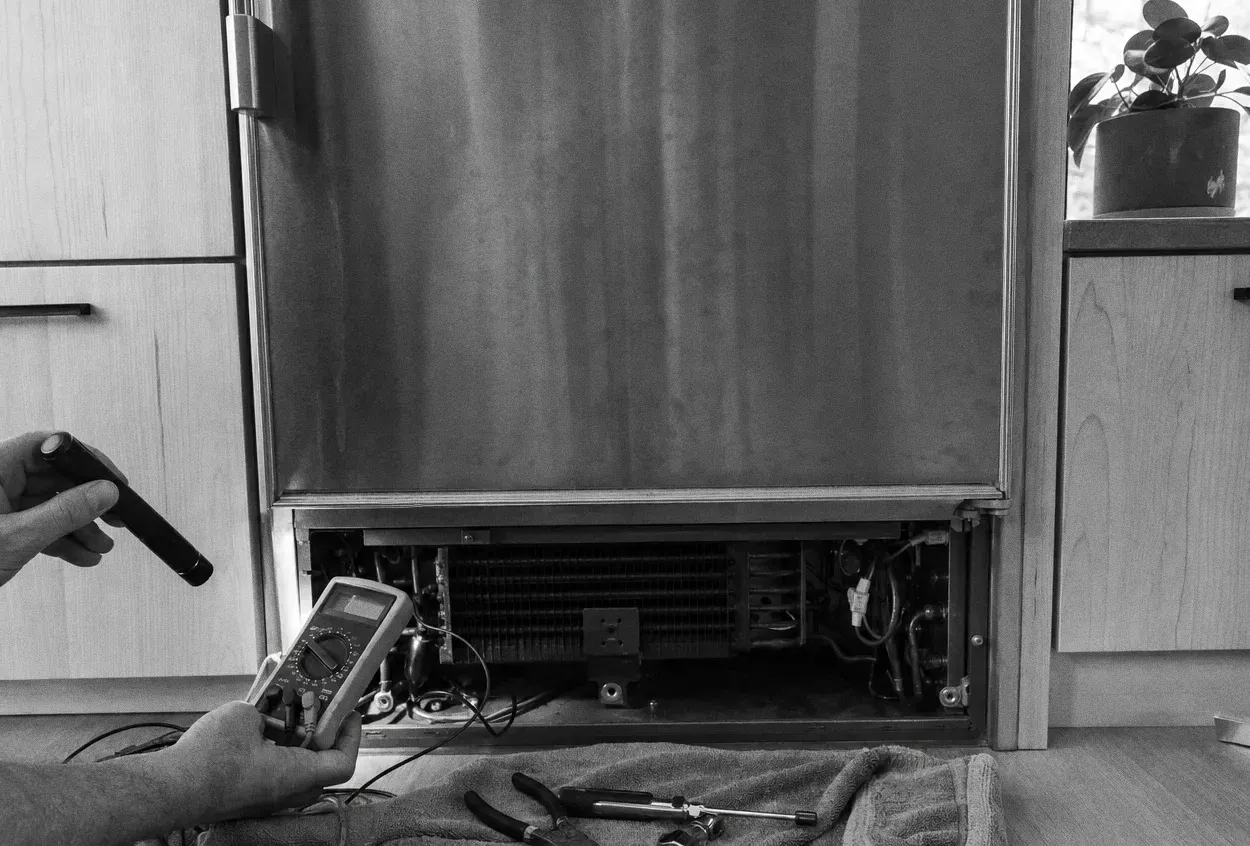
You reach into the bin expecting a handful and get something wrong instead. Cubes with a crater pressed into the top. Cubes so white through the middle they look carved out of a snowbank. A welded crust that has to be cracked against the side of the sink before anything usable falls out. Meanwhile the appliance runs quietly, the bin fills at some rate, and nothing about it announces a failure — which is why most households live with bad ice for a season before ringing anyone.
Nearly all of it is a water story. An ice maker is a simple and fairly unintelligent device: it asks for a measured amount of water, holds it until it is solid, and pushes the result out. Most of what goes wrong with the finished cube happened before the water ever arrived. So this walkthrough starts at the shut-off and works inwards, and it leaves the appliance itself until late.
Shape, clarity, size: three separate signals
Three unrelated complaints hide inside the phrase “bad ice” and they do not share a cause. A hollow or dished cube says less water reached the mould than the cycle expected. A cloudy cube says dissolved air and minerals came out of solution while it froze. A fused slab says the ice sat too long before release. Work out which one you have first.
There is a fourth signal that people fold into the others by mistake: a cube that is well shaped and reasonably clear but plainly smaller than it used to be. That is not the same as hollow. Hollow means the mould filled and the centre never got there. Small-but-solid usually means the fill itself has been reduced, or the cycle is being cut short.
Boston complicates the reading, because so many of these kitchens are not where they started. In Ashmont, where the larger Victorians have mostly been gutted and the kitchen dragged to the back of the house into what used to be the pantry, the tubing from the original supply point to the new one can be three times the length it was and threaded through joists nobody has looked at since the plasterers left. A cube shape that changed after a renovation is a plumbing question before it is an appliance question.
Supply line, valve and pressure
Find the shut-off that feeds the appliance and confirm it is genuinely open rather than nearly open. A stop left a quarter turn short after a remodel, a saddle valve throttling an old line, or tubing pinched behind a cabinet all deliver the same outcome: the mould underfills and the cube comes out hollow.
The stop is usually under the sink, sometimes in a basement ceiling below the kitchen, occasionally behind a small access panel in the next room. Trace the line rather than assuming. Saddle valves — the clamp-on fittings that pierce a pipe — went in by the thousand and they silt up; one that worked for ten years is not evidence it is working now.
Kinks are the Davis Square fault. Renovations there push refrigeration into former pantries and back halls where depth rather than width is the constraint, and a unit shoved back the last half inch to let a door close will fold the supply tubing against the wall. If the ice went wrong the week the floor was laid, or the week the unit was pulled out for something else, that is where to look.
Low supply produces hollow cubes rather than no cubes because the fill valve opens for a set period instead of metering a volume. Give it less pressure and it passes less water in the same window. The machine has no way of knowing it was short-changed, so it freezes what it got and presents the result as normal.
The filter, and the interval that lapsed
A saturated cartridge restricts flow well before it changes how anything tastes, so “the water still tastes fine” is not evidence the filter is good. Restriction shows in the ice first, because the ice maker is the one part of the appliance that depends on a measured fill arriving on schedule.
Aftermarket cartridges are the next question, and the answer is not uniform. Some are perfectly good. Some match the fitting dimensions without matching the flow rate, which is precisely the failure that produces a dished cube in a machine that was fine last month. Cubes that changed shape within a few weeks of a cartridge change are a strong lead.
Most units will take a bypass plug in place of the cartridge. Fitting one and watching the next several cycles is a useful test: if cube shape recovers, the cartridge was the restriction. It proves nothing else about the water, and it is a diagnostic step rather than a way to live.
As for how often the cartridge should come out, take that from the use and care guide for your own series. The interval is not the same across the range, and printing one number here would be the kind of confident wrong answer this trade already has too much of.
Scale in the mould and on the sensor
Water arrives carrying dissolved solids, and whatever does not leave inside the cube stays behind. Over months that residue builds a film in the mould and across the surfaces the machine uses to sense what it has made. Release gets less clean, readings drift, and because it arrives slowly nobody connects it to anything.
Households in Medford and households in Arlington Heights are not necessarily handed identical water, and the way to settle it is not the state of your kettle. It is the annual report your own water utility publishes. Read that before assuming anything about mineral content, because a guess here sends people out to buy equipment they do not need.
Softening is a separate question worth checking rather than assuming. If the house has a softener, establish whether the line feeding the appliance is taken off before or after it. Plenty are teed off the cold main ahead of the softener, which means the ice is being made from water the rest of the household does not drink, and the deposit in the mould is not what anyone thinks it is.
The appliance is not cold enough to make good ice
The figure on the display is the compartment set point, not the temperature at the mould. Ice forms inside a moving air stream, and where that stream is obstructed by how the compartment has been packed, freeze time stretches, cubes come out undersized, and production across twenty-four hours falls short of what the model is rated to do.
Look at what is stacked in front of the return and the outlet. A wall of flat boxes across the back is the usual offender, and it is invisible as a fault because everything in there is still cold. Cold is not the same as circulating.
Door habits matter too, and this is the honest part. A full house over a long weekend opens that door far more often than any specification assumed, and every opening costs recovery the machine has to make up before it can freeze at full speed again. Ice is usually the first output to visibly suffer, because it is the only one you inspect a piece at a time.
The release side of the cycle
Harvest is the second half of every cycle. Once the water has frozen, the machine warms the mould just enough to loosen the ice, and an ejector sweeps it down into the bin. Cubes fusing into a slab point at that step, or simply at ice sitting untouched in a bin nobody empties, rather than at any shortage of freezing capacity.
Watch a full cycle if you can catch one. The sensing arm should rise and fall — that is how the machine decides the bin is full. Ice mounded under the arm will hold it up, the machine stops making more, and from outside that reads as a breakdown when it is actually the appliance doing exactly as instructed. Level the bin and see what a day changes.
Slabs in a bin that is emptied regularly are a different matter. That points at timing: ice released late, sitting long enough in contact with the batch before it to bond into one piece.
Stop before you start chipping. Attacking ice in the mould with a knife or a screwdriver damages the surface the ice has to release from, and every harvest after that is worse than the one you were annoyed about. Do not take the module apart. The Ice Maker Repair page sets out what we handle on the module, the fill valve and the line feeding it.
The point where this needs a meter, not another guess
Water on the floor beside the unit, a damp supply line, or a compartment that will not hold its temperature are all reasons to stop testing and call. None of those is a cube-quality problem, and all of them get worse while being thought about.
What a technician measures is the part you cannot. Actual fill volume against what the cycle expects. Inlet pressure at the valve rather than at the nearest tap. Cycle timing checked against the specification for the series instead of against how long it feels.
Visits are $95. Where the fault turns out to be the module, the fill valve or the line running to it, that work sits between $290 and $690.
Davis Square, Arlington Heights and Ashmont are all inside our patch. There is nothing here to fill in and nobody to email. What sits above is a number to ring and a link that books the visit.
Still asked on the phone
Does an aftermarket filter cartridge matter?
It can. Some aftermarket cartridges are perfectly serviceable; others match the housing dimensions without matching the flow the appliance expects, and a restricted fill is exactly what produces a dished or hollow cube. If the shape of your ice changed within a few weeks of swapping cartridges, put the original type back and watch the next dozen cycles before looking anywhere else.
Should I throw away the first batch after a filter change?
Yes, and the second batch is worth losing too. A new cartridge carries loose carbon fines and trapped air, both of which turn up as grey flecks or an odd taste in the first ice made after fitting. Discard what the bin produces over the first day, let the machine settle into its rhythm, and judge the cartridge on what it makes after that.
Is it worth fitting a whole-house softener for this?
Not on the strength of poor ice alone. Softening changes what is dissolved at every tap in the house, so it is a decision about the whole plumbing system rather than about one appliance. Start by reading the annual report your water utility publishes, then find out whether the line feeding the appliance is even taken off downstream of a softener you may already own.